Paint correction removes swirl marks without damaging a vehicle’s clear coat by precisely leveling the topmost layer of the transparent resin down to the depth of the scratches. Rather than filling in or hiding these imperfections, this process uses abrasive compounds to shave away microscopic amounts of damaged material, creating a flat, uniform surface that reflects light evenly. When executed by a professional using precision tools, the correction targets only the micro-layer of damaged paint while leaving the structural integrity of your factory finish completely safe and intact.
The Microscopic Defect: Why Swirl Marks Dull Your Finish
If you have ever parked your vehicle under the bright Arizona sun, you have likely noticed those distracting, spiderweb-like micro-scratches dancing across the hood. These swirl marks steal your car’s natural depth, dull its reflection, and make even a clean car look weathered. Understanding how to eliminate these eyesores without compromising your finish requires looking at the physics of modern automotive paint. Let’s break down the mechanics of the Marana paint correction process, explore how we safeguard your exterior, and examine how to secure long-lasting surface clarity.
Understanding Your Vehicle’s Paint Anatomy
To understand how paint correction in Marana safely removes imperfections, you first need to understand the anatomy of modern factory paint. Almost every vehicle built over the last three decades utilizes a multi-stage paint system consisting of three distinct layers:
- The Primer Layer: The foundational base applied directly to the bare metal or composite panels of your car to prevent rust and ensure paint adhesion.
- The Base Coat (Color Layer): This is the thin, pigmented layer that gives your car its color, containing no built-in gloss or UV protection.
- The Clear Coat: A transparent, specialized polyurethane or acrylic resin applied over the base coat.
The clear coat provides sacrificial protection, shielding the delicate color layer from UV rays and environmental fallout. Swirl marks and scratches are simply tiny, V-shaped valleys gouged into this transparent layer. When sunlight hits these uneven grooves, the light scatters instead of reflecting directly back to your eyes, creating the optical illusion of circular cobwebs.
The Mechanical Precision of Leveling, Not Filling
True paint restoration is a subtractive mechanical process. To make a scratch disappear, you must carefully level the surrounding clear coat until it matches the exact depth of the lowest point of the defect. Once the surface is completely flat again, light reflects symmetrically, restoring true clarity and deep color contrast.
To accomplish this safely, professional detailers utilize a highly calibrated combination of machinery, abrasive liquids, and pad physics:
- Dual-Action Polishers: These modern machines oscillate and rotate simultaneously to distribute heat evenly across the body panel, minimizing the risk of friction-induced paint burns.
- Diminishing Abrasives: Premium leveling compounds contain microscopic particles that start sharp to level defects, then break down into finer shapes to polish the surface during the cycle.
- Pad Dynamics: The density of the polishing pad (whether wool, microfiber, or varying grades of foam) dictates how aggressively the abrasive compound interfaces with the paint work.
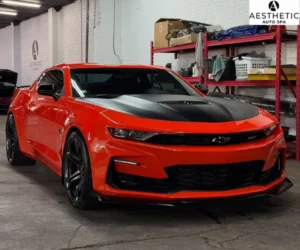
During a recent paint correction in Marana, AZ assessment for a client, we encountered a black sports car with heavy wash swirls and surface oxidation. By utilizing a multi-stage correction beginning with a heavy microfiber cutting pad and a heavy leveling compound, followed by a soft foam finishing pad and an ultra-fine jeweling polish, we leveled the clear coat safely, revealing a flawless, mirror finish without over-thinning the protective factory resin.
Safeguarding Your Clear Coat with Advanced Diagnostics
Factory clear coats are surprisingly thin, usually measuring between 35 to 50 microns thick (roughly the thickness of a post-it note). Of that total thickness, a professional should only remove a tiny fraction (usually 2 to 5 microns) during a comprehensive restoration. Removing too much material compromises built-in UV blockers, which can eventually lead to clear coat failure or premature peeling.
To eliminate guesswork, true paint preservation relies on advanced diagnostic tools:
Digital Ultrasonic Paint Depth Gauges
Before any machine touches your vehicle, a technician uses a digital gauge to take multiple measurements across every single panel. This tool measures the exact total thickness of the paint system down to the bare metal or substrate. By mapping out the vehicle’s paint depth, we can identify thin spots, historical correction work, or panels that may have been resprayed. If a specific area indicates low readings, we modify our approach, using a less aggressive pad and compound combination to preserve the paint’s longevity.
Test Spots and Temperature Control
Friction creates heat, and excessive heat is the absolute enemy of automotive finishes. Modern resins can soften or become sticky if subjected to extreme temperatures during polishing. Professionals continuously monitor panel temperatures and always perform a controlled test spot on an inconspicuous area of the vehicle. This allows us to find the least aggressive combination necessary to deliver flawless results.
Elevating Protection Beyond the Polish
Achieving a flawless, swirl-free surface is only half the battle. Once your vehicle’s paint has been corrected to perfection, it is completely bare, highly vulnerable, and lacking any form of protection. Leaving it exposed to the intense desert heat and environmental variables in regions like Marana, AZ would quickly undo all of the meticulous leveling work.
To preserve this pristine finish, it is essential to seal the leveled surface with advanced protection systems. This is where automotive enthusiasts who bring skill, dedication, and passion to every project turn to premium ceramic coatings and paint protection films (PPF).
Our expert services are designed to lock in that newly restored clarity while introducing unmatched durability and protection against future wear and tear. When a high-solid ceramic coating is applied to a perfectly corrected surface, it chemically bonds with the factory resin on a molecular level. This creates an ultra-hard, hydrophobic top layer that acts as a secondary sacrificial barrier.
This advanced coating provides extensive benefits for daily drivers and collector cars alike:
- It simplifies future cleaning and maintenance because the hydrophobic properties repel water, dirt, mud, and road grime, allowing contaminants to wash away with minimal physical agitation.
- It reduces future swirl marks because dirt doesn’t stick tightly to the slick ceramic surface, mitigating the primary cause of washing swirls.
- It shields the remaining factory clear coat from oxidation and fading caused by constant exposure to intense solar radiation.
People Also Ask
Does paint correction remove deep scratches that go down to the metal?
No. The process can only safely remove scratches and imperfections that reside entirely within the transparent top layer. If a scratch has penetrated through to the primer or bare metal, it cannot be polished out. Such deep defects require localized touch-up paint or professional body shop respraying to fix.
How many times can a car undergo machine polishing?
Because factory clear coat is limited, a vehicle can generally undergo a heavy, multi-stage restoration only two to three times in its lifespan before the paint becomes dangerously thin. However, if the vehicle is properly maintained via safe hand-washing techniques and protected with a ceramic coating or PPF, it should only ever need a full correction once. Light, non-aggressive finishing polishes can be used more frequently to maintain gloss.
What is the difference between buffing, polishing, and paint correction?
“Buffing” and “polishing” are broad terms that often refer to quick, single-stage machine operations designed to boost surface gloss or hide defects temporarily using glazes and waxes. Paint correction is a highly precise, multi-stage mechanical leveling process that utilizes paint depth gauges, specific abrasive combinations, and extensive labor to permanently eliminate surface defects by leveling the clear coat itself.
Experience True Automotive Restoration at Aesthetic Auto Spa
Your vehicle is more than just a way to get from point A to point B; it is an extension of your lifestyle and a significant investment that deserves honest, elite-tier preservation. At Aesthetic Auto Spa, we completely reject marketing gimmicks, cutting corners, or temporary fixes. We believe that true quality comes from a combination of deep technical knowledge, premium equipment, and an authentic passion for the automotive craft.
Ready to restore your car’s finish to its absolute peak potential and secure a level of protection that simplifies future cleaning and maintenance? Contact us today and let us deliver the clear, reliable, and spectacular results your vehicle deserves.